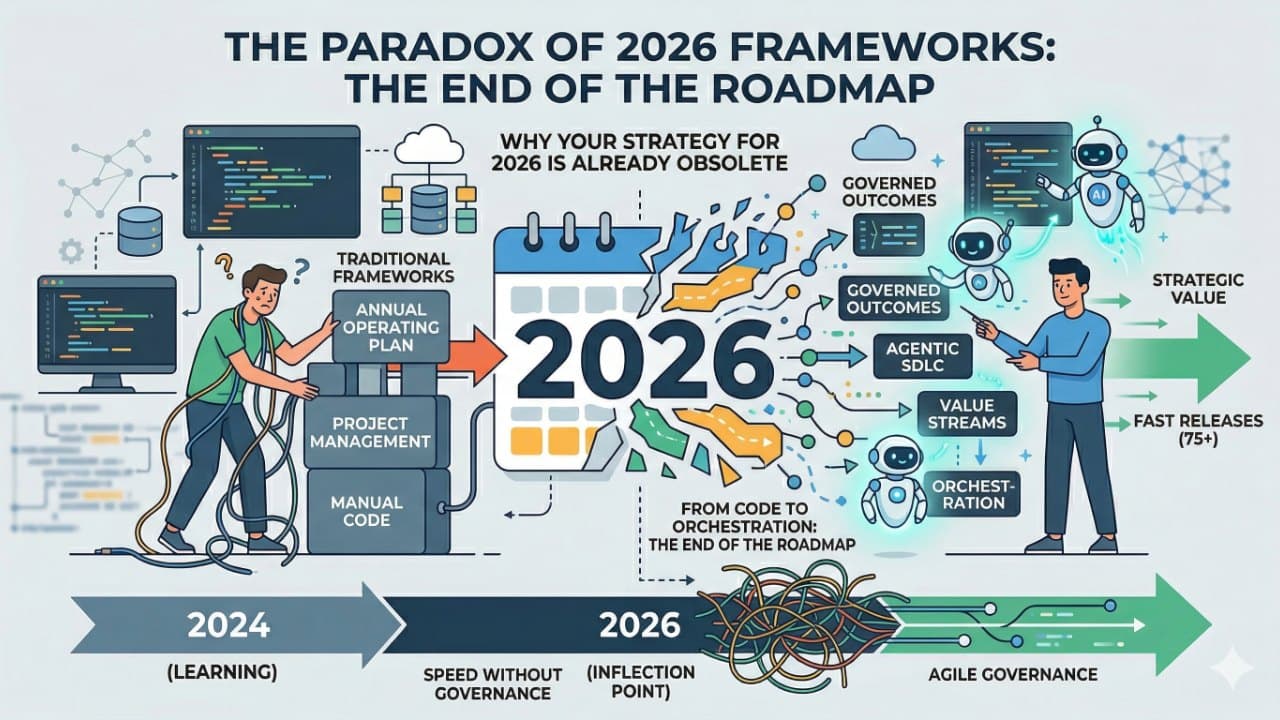
The End of the Roadmap: Why Your 2026 Strategy is Already Obsolete
By 2026, the industry has moved to a regime of Governed Outcomes. It is no longer enough to simply generate code; we need value.
1. The Hook: Navigating the 2026 AI Inflection Point
By 2026, the novelty of "AI for the sake of AI" has vanished. While nearly every enterprise has integrated generative tools, a stark divide has emerged between those seeing marginal gains and those undergoing a total business transformation.
In a recent study of 377 technology leaders across the Middle East—specifically the GCC, Jordan, and Egypt—the consensus is clear: we have reached an inflection point. The industry is moving from the era of "Faster Reports" to a regime of Governed Outcomes.
- It is no longer enough to simply generate more code.
- The goal is now to ensure that every AI-driven output translates into measurable reliability and strategic value.
- If you’re still measuring success by the number of prompts sent rather than the quality of the outcome, you’re already behind.
2. The Death of the Annual Operating Plan
For decades, the 12-month budget cycle was the "command and control" anchor of the enterprise. In 2026, that anchor is a liability. As AI shortens the gap between a business idea and its digital realization, the friction of static, annual budgeting has become a primary bottleneck to growth.
Jean-Louis Vignaud, head of ValueOps at Broadcom, identifies this as a fundamental shift from "Project" thinking to "Product" (Value Stream) funding. Traditional project management brings too much oversight and complexity for a cycle that now moves at agentic speed. The future belongs to organizations that fund nimble, continuous value streams.
3. Coding is the Low-Hanging Fruit; Downstream is the Real Prize
A common strategic mistake in early AI adoption was focusing solely on the editor. While 55.4% of teams use AI for coding, the revolution has already moved further upstream and downstream.
Surprisingly, Ideation (56.8%) has surpassed Coding as the most AI-augmented stage. However, the largest untapped opportunities reside in the downstream stages. According to PwC research, teams that leverage AI for maintenance and refactoring see a staggering uplift of 37 additional releases per year.
To move beyond the "low-hanging fruit," leaders must automate:
- Testing: Autonomous defect detection.
- CI-CD: Automating integration for production-grade reliability.
- Monitoring: Predicting system failures.
- Maintenance: Streamlining technical debt refactoring.
4. From Code Executor to System Orchestrator
The structural transformation of the developer role is now a settled reality. We are witnessing a migration from manual writing to higher-level oversight.
Executor of Code → Orchestrator of Systems
But this shift brings a "Productivity Paradox." Data suggests that the velocity of AI-generated code is currently outpacing the maturity of delivery systems. Without robust governance, this speed leads to deployment instability.
5. The Resource Paradox
In the pre-AI world, the primary constraint was resource capacity. Today, the bottleneck has shifted from execution to strategy. The question has moved from capacity to value: "Are we investing in the right place?" Modern platforms now allow executives to identify projects at risk in real-time, forcing a focus on high-confidence decision-making.
6. The "Pioneer" Advantage: 75 Releases vs. 41
A two-speed transition is emerging. "Pioneers"—teams that augment six or more SDLC stages—are leaving others behind:
| Metric | Pioneers | Observers |
|---|---|---|
| Velocity | 75 releases per year | 41 releases per year |
| Quality | Software defects cut by up to 96% | - |
| Capability | 87% rate AI skills as high | 34% rate AI skills as high |
7. The Governing Constraint
As an organization matures, its barriers to AI shift. For Observers, the fear is external (security/cost). For Pioneers, the challenge is internal: governance and model oversight. A counter-intuitive finding is that 41% of mature teams favor closed-source models for their stable integration and clearer security assurances.
8. Conclusion: The Agentic Future
We are rapidly approaching the "Agentic SDLC," where AI is a collaborator in complex decision-making.
- By 2027: Half of regional teams will operate a fully augmented SDLC.
- By 2029: That figure will rise to two-thirds.
Is your organization prioritizing the speed of code generation, or the strategic value of the outcome? In the age of the orchestrator, governance is the competitive advantage.
Comments
Sign in with Google or GitHub to comment.