Ruby 4.0 and the 2026 Security Crisis: 6 Impactful Takeaways for the Modern Developer
Ruby 4.0 (2025) marks a shift to runtime evolution. By 2026, EOL for 3.2 and new CVEs make this upgrade a mandatory security defense.
1. Introduction: The 30-Year Pivot
[cite_start]On December 25, 2025, the Ruby community celebrated its 30th anniversary with the release of Ruby 4.0[cite: 3]. [cite_start]Unlike previous major updates, this version focuses on a managed evolution of the runtime layer rather than breaking syntax changes[cite: 4]. [cite_start]However, by Spring 2026, a high-priority security mandate and the End-of-Life (EOL) of the 3.2 series turned this release into a "forced march" for developers[cite: 5, 6].
2. The "Matz Impression": Why Version 4.0 is Counter-Intuitive
[cite_start]Ruby 4.0 does not follow strict semantic versioning (SemVer)[cite: 8]. [cite_start]Instead, creator Yukihiro “Matz” Matsumoto chose the version number to celebrate the language's 30th birthday[cite: 9].
- [cite_start]Focus: Structural maturation, isolation, parallelism, and compiler efficiency[cite: 10].
- [cite_start]Goal: Positioning Ruby to compete with languages prioritizing rigid concurrency and type systems without losing developer ergonomics[cite: 11].
3. Ruby::Box: Containers Inside Your Process
[cite_start]An experimental feature that introduces isolated "containers" or namespaces within a single Ruby process[cite: 13, 14]. [cite_start]It is enabled via RUBY_BOX=1[cite: 15].
Key Benefits of the Isolation Model:
- [cite_start]Strict Confinement: Definitions like monkey patches, global variables, and constants are confined to the Box[cite: 17].
- [cite_start]Blue-Green Deployment: Run two versions of an app in one process and switch traffic between them[cite: 19].
- [cite_start]Dependency Protection: Prevents libraries from "poisoning" the global namespace[cite: 20].
- [cite_start]Safe Evaluation: Test dependency updates in parallel boxes to compare results before committing[cite: 21].
4. The 2026 Security Crisis
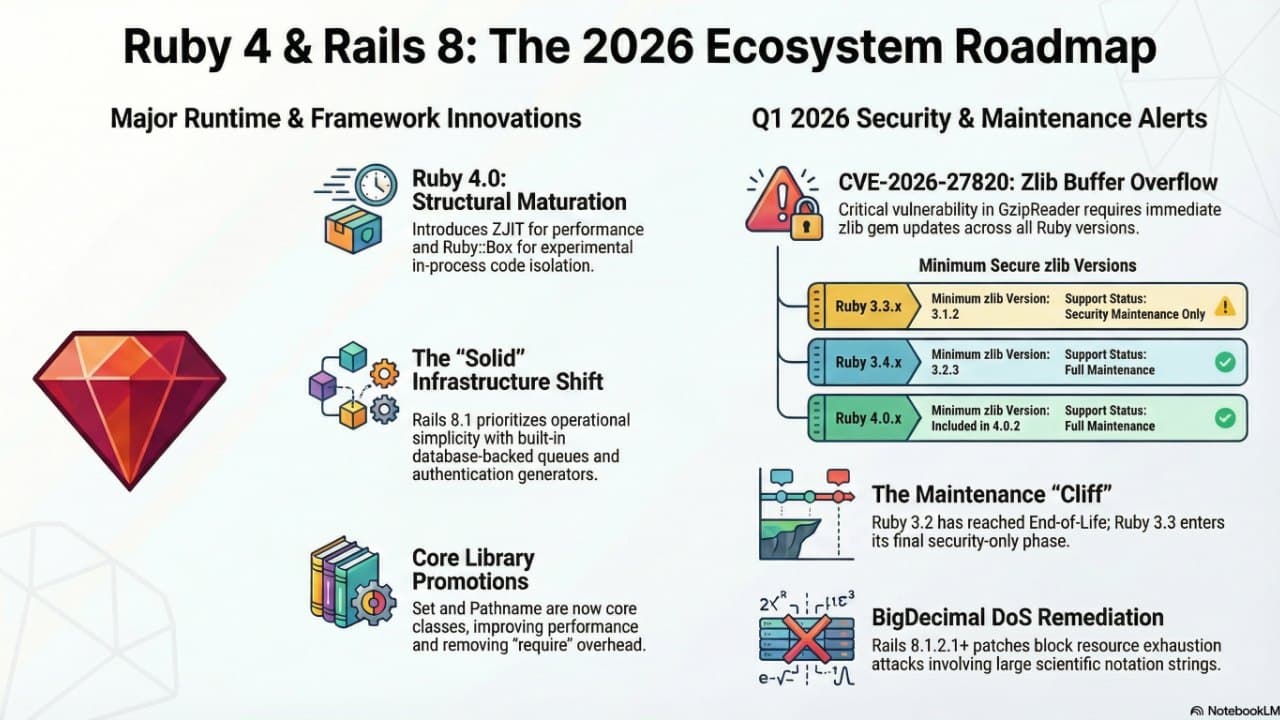
[cite_start]In March 2026, two major vulnerabilities required synchronized updates across the ecosystem[cite: 23].
| Ruby Series | Maintenance Status | Required zlib Gem Version |
|---|---|---|
| Ruby 3.2 | End-of-Life (EOL March 2026) | 3.0.1 |
| Ruby 3.3 | Security Maintenance (EOL March 2027) | 3.1.2 |
| Ruby 3.4 | Full Maintenance | 3.2.3 |
| Ruby 4.0 | Full Maintenance | 3.2.3 (Integrated in 4.0.2) |
| [cite_start][cite: 28, 29, 30, 31] |
Major Vulnerabilities:
- [cite_start]CVE-2026-27820 (Zlib Overflow): A buffer overflow in
Zlib::GzipReaderthat could lead to arbitrary code execution[cite: 24, 25]. - [cite_start]CVE-2026-33176 (BigDecimal DoS): Scientific notation (e.g., "1e10000") could cause massive CPU/memory consumption in Active Support, leading to a Denial of Service[cite: 26, 27].
5. The "Solid" Revolution: Rails 8.1
[cite_start]Rails 8.1 embraces the "Solid" stack, focusing on operational simplicity by using database-backed defaults[cite: 33, 34].
- [cite_start]Solid Queue: Replaces Redis-dependent systems with a database-backed alternative[cite: 35].
- [cite_start]Authentication Generator: A built-in production-ready system to reduce reliance on gems like Devise[cite: 36].
- [cite_start]PostgreSQL Resilience: Improved handling of asynchronous exceptions during reconnections[cite: 37, 38].
6. ZJIT: Raising the Performance Ceiling
[cite_start]Ruby 4.0 introduces ZJIT, a next-generation JIT compiler utilizing a method-based strategy and Static Single Assignment (SSA)[cite: 40, 41].
- [cite_start]Optimizations: Allows for aggressive inlining and dead-code elimination[cite: 42].
- [cite_start]Requirements: Needs Rust 1.85+ to build[cite: 43].
- [cite_start]Status: Experimental; currently slower than YJIT for typical web workloads[cite: 45].
- [cite_start]Activation: Use
--zjitorRUBY_ZJIT_ENABLE=1[cite: 46].
7. Core Promotions and "Sharp Edges"
- [cite_start]Core Promotions:
SetandPathnameare now core classes[cite: 48]. [cite_start]Setis now reimplemented in C for better performance[cite: 49]. - [cite_start]SortedSet Removal:
SortedSetis no longer in the standard library; users must install thesorted_setgem[cite: 51, 52]. - [cite_start]Net::HTTP Change: It no longer automatically sets
Content-Type: application/x-www-form-urlencoded[cite: 53]. - [cite_start]Splatting nil:
*nilno longer invokesnil.to_a, matching**nilbehavior[cite: 55].
8. Conclusion: A Look Toward 2027
[cite_start]The Ruby ecosystem is at a "maintenance cliff"[cite: 57]. [cite_start]With Ruby 3.2 now dead and 3.3 on its final year of support, staying current is no longer a luxury but a defensive requirement to remain secure[cite: 57, 59, 61].
Comments
Sign in with Google or GitHub to comment.